
THE BUSINESS OF STRENGTH: HOW APRIL D. JONES IS PROVING WOMEN CAN HAVE POWER, FAMILY, AND FREEDOM
There are women who enter a room and quietly take their seats. And then there is April D. Jones.
Founder and principal of Jones Law Firm, PC, one of Colorado's largest family law firms, April has spent 25 years doing something law school doesn't teach: being the person in the room with the most strength, when her clients have the least. From the courtroom to the conference table, she shows up not just as a lawyer, but as an anchor. And she is very, very good at it.
She built Jones Law Firm from nothing, with babies on her hip, in a time when the legal world wasn't exactly rolling out the welcome mat for Black women with growing families. What she built instead is extraordinary: a firm rooted in strategy, steeped in culture, and governed by a simple but powerful principle; you can be formidable without burning the whole thing down.
Today, Jones Law Firm occupies its own building in the Denver Tech Centre, and April is set to become the first Black woman president of the Colorado Bar Association. April leads a team of lawyers who, in her words, "practice law like chess"; strategic, thoughtful, and always three moves ahead. She speaks to packed rooms about ambition, motherhood, and the long journey from the girl who learned to make herself smaller so the room wouldn't feel overwhelmed, to the woman the room is now built around. The little girl who once carefully unfolded herself, so as not to be too much, is now booked precisely because of everything she is. They ask for all of April. And all of April, it turns out, is extraordinary.
We knew immediately she was our kind of woman. Over to you, April…
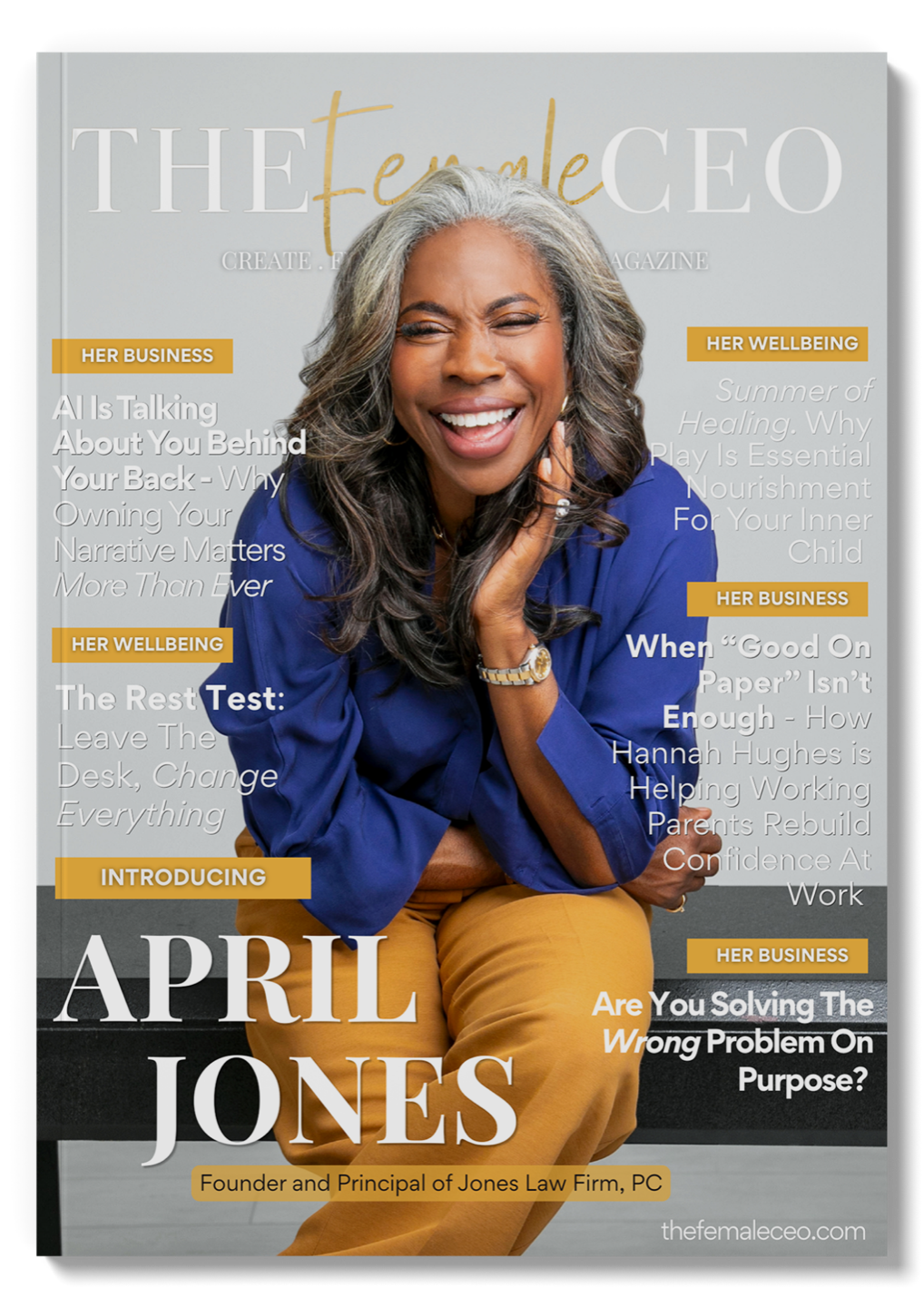
So, April, what's your story?
My story starts on a bus. My mother was a single mom in South Los Angeles; she made my clothes, she worked in Compton's schools, put me on a bus to a school in the Valley, an hour each way in LA traffic, around people I'd otherwise never have met. From the outside, it looked like too much. Why would you do that to a child? But that ride taught me the thing I've leaned on my whole life: when something requires a great deal up front, you can do it, and you get back what you put in. We put in a lot, and we got a lot.
Everything after that is a version of the same lesson. I became a lawyer. I learned, working at a San Francisco firm, what it could mean for a woman to take up her full space without apology. I left a firm rather than shrink myself around a second pregnancy. I started Jones Law Firm with babies on my hip. And somewhere in the 25 years since, while I was planning to close it one day and go to the bench, I looked up and realized I'd built something I actually wanted to keep. So I kept it. That's the short version.
The bus ride to the Valley — what did that journey teach you about yourself, and about what was possible?
It was long. Really long. And that's the first thing it taught me: that effort that looks ridiculous from the outside can be exactly the right thing to sign up for. Why would you put a child on a bus for an hour each way to go to school, nowhere near home, around people they'd otherwise never know? Because of what comes back. That became a tool in my tool chest, as ordinary to me now as a wrench or a hammer: if something looks like it takes a great deal, you can still do it, and you can derive so much from it. Other people go to the school around the corner and put in a mediocre effort and get a mediocre return. We put a lot in early, and I've been able to replicate that for life. It's doing the hard thing — and realizing the hard thing isn't even hard. It just looks hard to everybody else.
The other half was learning where I belonged. I'd go to this new environment and still show up the same way, one of the smartest kids in the class, asked to lead. And then I'd ride the bus home through my own neighborhood, where one of the girls in our group was carrying the boys' guns in her purse. The Crips were from my streets. I'd rub up against all of it and think, no, that's not me. But this, leading over here, that is me. Having both worlds available is what let me see clearly where I fit. If I'd never had that space, I wouldn't have known.
You taught yourself to read the room and unfold slowly. How did a little girl figure that out, and what did it cost you?
Even in junior high, I was making strategic decisions about timing. If you wanted to run for class president, you didn't run the semester Henley Hawkins was running — he played football, he was popular, he was a handsome guy, he'd win. So you ran a different semester. It felt enormous at the time, and looking back, it was genuinely formative: learning to read a room, to see the whole board, to know when to step forward and when to wait. That instinct never left me.
The cost of unfolding slowly is the creases. I have creases because the fact that I now feel welcomed and invited to be my full self as the price of admission into big rooms means the opposite was true for a long time.
What does it feel like to walk into a room knowing you don't have to dim a single thing?
It feels really good. Not in a puffed-up, look-at-me way, not that kind of good. It feels good to be whole and accepted, and not just accepted but actively wanted. You were invited into this space for what you bring. The very thing you have is the thing they're asking for. What a treat that is.
The golden thread running through everything you've wanted to be — what is it, and when did you first recognize it?
The simple way to say it is service. But service isn't what grabs me. It's being in service to people who need the strength that I have, that I'm strong enough to share. They need someone intelligent and specialized who can stand in a hard space and do important things, and I want to do that for them, in that place, at that time. You have a need; I have a strength; I want to meet it. If someone wants to call that service, fine. But that's the thread.
Being someone's strength in the exact moment they have none of their own — where does that come from? Born with it, or developed?
My husband is six foot five. Strong, muscular. When something needs to come off a high shelf or a big box needs to come into the house, he just reaches in and gets it because it's light to him. That's how this feels to me. I'm operating in a space that is light to me. So why wouldn't I help people who could use the strength? When the thing that's heavy for everyone else is light for you, sharing it isn't a sacrifice. It's just what you do.
The female partner with the pink office — what did it mean to you, and how did it shape your career?
I was struck by it. And the fact that it struck me so much, even now, tells me I was seeing something about women that I hadn't fully put words to. This was 1988. There was so much in what it meant that an office could be painted pink in how women were seen in that world. I'd gone to Berkeley, I'd protested plenty of things, I'd been raised by a woman and gone to an all-girls school, but I could appreciate, maybe without even realizing it, how limited our roles were even in those elevated rooms. If you never expected to be let into the room, you haven't felt yourself shut out of it yet.
And here was a senior woman partner who just owned it. That's what I loved. She owned that she was a woman, and she made the office pink, and she showed up and said, this is what I'm bringing, and what I'm bringing is additive, try it, it'll be good for you. She never sat me down and mentored me. Maybe painting that office pink put a bullseye on her and cost her something. But to me, the brand-new college grad looking up, what might have been a bullseye looked like a beacon.
After graduation, you left a firm rather than disclose your second pregnancy, and "second child bias" — how do you feel about how you were treated, and what would you say to your younger self?
Honestly, I didn't even know I was being treated a particular way back then. I felt the pressure to perform and felt I couldn't meet it in the way that was traditionally expected of me. So I'd say I was more tapped out than pushed out. And I've watched that happen to women over and over, in the law and outside it. You have a baby, you tap out.
I think about a season after I’d moved to Colorado in summer 1998, when my 3 kids were ages 2-5. I hadn’t started my Colorado law practice yet, so I had a lot of playdates. One mom had been a sports photographer hanging out of helicopters. One had been a news anchor. There was me, the lawyer. I was struck by the sheer workforce power sitting in that room, formidable women, all of us pulled out for the little kids. We say we "tapped out," but really we tapped into something else.
So what would I say to my younger self? I'd say: good job working the container that was available to you. We all did what we could with what we had, inside the container we were handed. And I'd resist anyone trying to get me to edit my past self, or to suggest the women who did it differently did it wrong. They didn't. We were all operating inside the same walls.
Building a firm from scratch with small children — what was the reality, and what kept you going?
Thinking creatively, constantly. That was the whole game. When you have small children, every stage frees up a little more time. I genuinely remember the milestone of not having to wrestle anyone out of a car seat, when everyone could just walk into the house themselves. That felt like a win, because it was time I could finish a call quietly in the car, a trickle of time back into the firm.
What kept me going is that I wanted both. I loved the time with my kids, and I loved practicing law, and the question that drove me was: how do I get to do both? So you reconfigure. And you keep reconfiguring, until one day you come home from work and the house is empty because everyone's at practice and games and they won't be back for two hours, and now that time is yours. I just kept taking the time back and putting it in the April column. That's how I did it.
Planning to close the firm for the bench, then realizing you'd built something extraordinary — what was that moment, and why the firm over the bench?
The plan was to go on the bench once the last kid graduated from college, and we had graduations three out of every four years for about twelve years, including 2 Ivy League ones, so that last graduation from Harvard and from the expense of it all was a real treat. What I hadn't noticed was that I was still operating under a constraint I'd set a decade earlier. The deal I'd made with myself was: when the last one graduates, I get to look around and decide what I actually want.
And when that day came, I pictured the bench honestly, a beautiful courtroom where you go, and you stay, all day, into the night, and I thought, I don't think I want that. What I wanted was to create. I looked at my own firm, at all the processes and procedures I'd never gone back and fixed, the things that had quietly nagged at me, and instead of seeing an eyesore, I thought: I could just tweak this. I could make it something I'm proud of, what I think a law firm should actually be, for women and for everyone. That's when it hit me. It was never the Supreme Court or nothing. It was the Supreme Court or anything. And I chose this.
Hiring lawyers who are "aggressive externally but not internally" — how do you find them, and how does the culture hold as you grow?
We screen for it, hard, long before anyone gets to me, and I'm the last interview. By the time a candidate reaches my desk, my team, from HR to my firm administrator to the leadership, has already run them through a process that makes plain who we are and what that means here, and tests whether it resonates.
It starts in the job description itself. We write the whole thing to speak to our avatar, and just as importantly, to not speak to the person who doesn't actually want a collaborative team. Because not everyone does. Some people run on the thrill of victory and internal competition, and that's fine, it's just not us. From the posting all the way through the process, every step is built to showcase who we are and call in the people who belong here. And we do that well.
Joining a coaching program and hitting over 600% growth since 2019 — what actually changed, and what do you wish someone had told you sooner?
Running a law firm like a business. I would have told you I was running mine like a business. You go to law school, hang a shingle, get cases, do good work, bill, get paid. Simple enough. But the metrics behind it were a whole world I didn't know existed. The coaching material described being able to run your firm from the metrics — that you could, in theory, not even walk into the office and still run the place because the numbers tell you everything. After nineteen years of doing it the other way, that spoke to me. It was a simplifier.
And here's the part I wish someone had told me sooner: anybody can do this. We're just never trained to. They don't teach it in law school, or dental school, or most professions, how to actually run the business. That was the difference. Wanting to do it, then building it. It creates order, and order creates expectation, and once you have order in the operational side, you're finally free to deliver on the real promise, caring for your clients strategically and thoughtfully because everything underneath it is running by the numbers.
"Aprilisms" — give us one of your favorites and tell us where the gift comes from.
Aprilisms are often so simple. But they pack punch and life and lessons and inspiration.
Like…
Do it or don’t do it. Just pick.
Once you give people the freedom to make a choice, but you demand that once they make this choice, they go all in, they show up, they do their best… , they DO IT.
Then they don’t make excuses, then it’s on them because they made the choice, not you, and it’s a simple concept but so much flows from it when you insist people make a decision and pick … like shut up and pick. It’s huge. My daughter was in pageants and wanted to be Miss Colorado and Miss America on her own. Not my idea. People wanted to assign pageant mom status to me, and I was adamant. This was her choice but the thing is once she made the choice, I was like, then you’re gonna show up you’re not gonna grab your gown when you go to walk off stage, you’re not going to snap at girls talking to you when you’re wearing a crown and a sash and I think that kind of freedoms gives agency to people, but it also makes demands all in so few words.
Motherhood and ambition — what do you want every woman to walk away knowing, and what has motherhood taught you that the firm never could?
What I want every woman to know is practical, and it starts with one question: What do you actually want to do? Once you've decided that, the only question left is how to make it all happen, and the answer is, lean into your strengths and hire to your weaknesses. If you're doing what you want to do and playing to your strengths, the whole haul gets easier. Stay in your career and have a nanny who does the cooking and cleaning you hate, so the time you get back is time with your kids. Buy your time back, wherever it fits for you, and nobody else can tell you where that is, because it depends entirely on who you are and what you need. Be strategic. Build the bubble world around you that lets you live out as many parts of yourself as you want, then thoughtfully fill the gaps so you can operate in your strengths without guilt. It can be done. You just have to be open to it, allow yourself to do it, and stop apologizing.
What motherhood taught me that the firm never could, lives somewhere between the most precious thing you can imagine and pure thanklessness. You go all in, you deny yourself, you pour everything into honing the gifts of these little people who depend on you; it is so much work, and it has a rewarding component nothing else can touch. And being your full self as a woman has its own sweetness that nothing else can touch, either. The trick is spending enough time in both lanes until, eventually, they converge back into one.
The next chapter, and your legacy.
I'm genuinely looking forward to what I can build as bar president (April is set to become the first Black woman president of the Colorado Bar Association), the relationships, the connections, the chance to see and create opportunity that actually matters. That's what the next chapter is: figuring out the space I get to operate in and give back in a way that means something. I want to find a give-back space so right for me that walking into it is its own reason to wake up energized and go.
I haven't landed on exactly what that is yet, and I'm looking forward to giving myself the chance to look around and find it. Where's the need that speaks to me, the thing I can go all in on with my time, my money, my resources? That's the part I'm most excited to figure out.
Motivational song for The Female CEO playlist.
"It's Your Thing" by the Isley Brothers. Do what you want to do. Thirty years ago, I took a deposition training where you had to pick a walk-up song for trial prep, and that's the one that's stayed in my head ever since.
Quickfire Round
- Coffee or tea? — Tea
- Courtroom or boardroom? — Courtroom
- First thing you do every morning? — Check my text messages
- The quality every great leader needs? — Grace (these people will drive you crazy)
- What word describes this season of your life? — Power
- What do women need more of? — Power
- What are you unapologetic about? — Power
- One word for success? — Joy
- One word for April D. Jones? — Free
To learn more about April visit Jones Law Firm, PC, or follow April on Instagram.