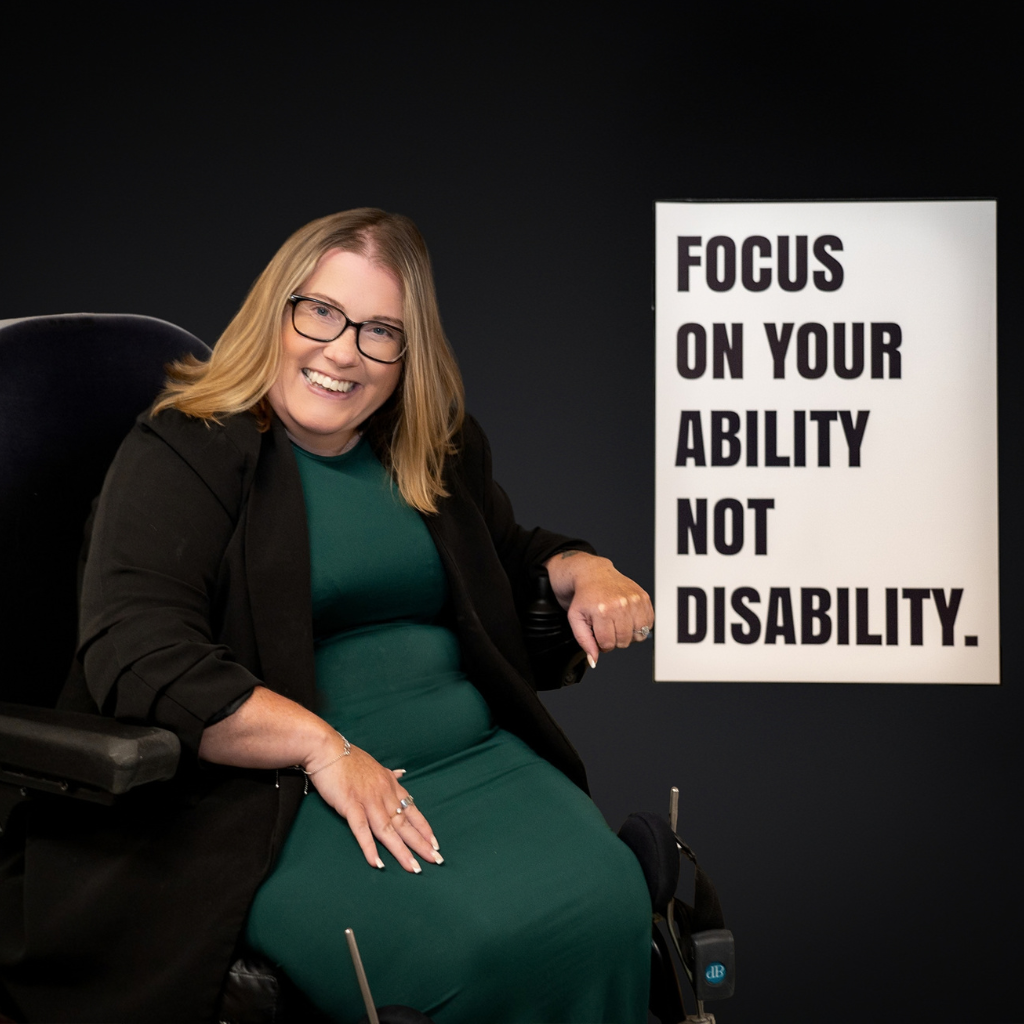
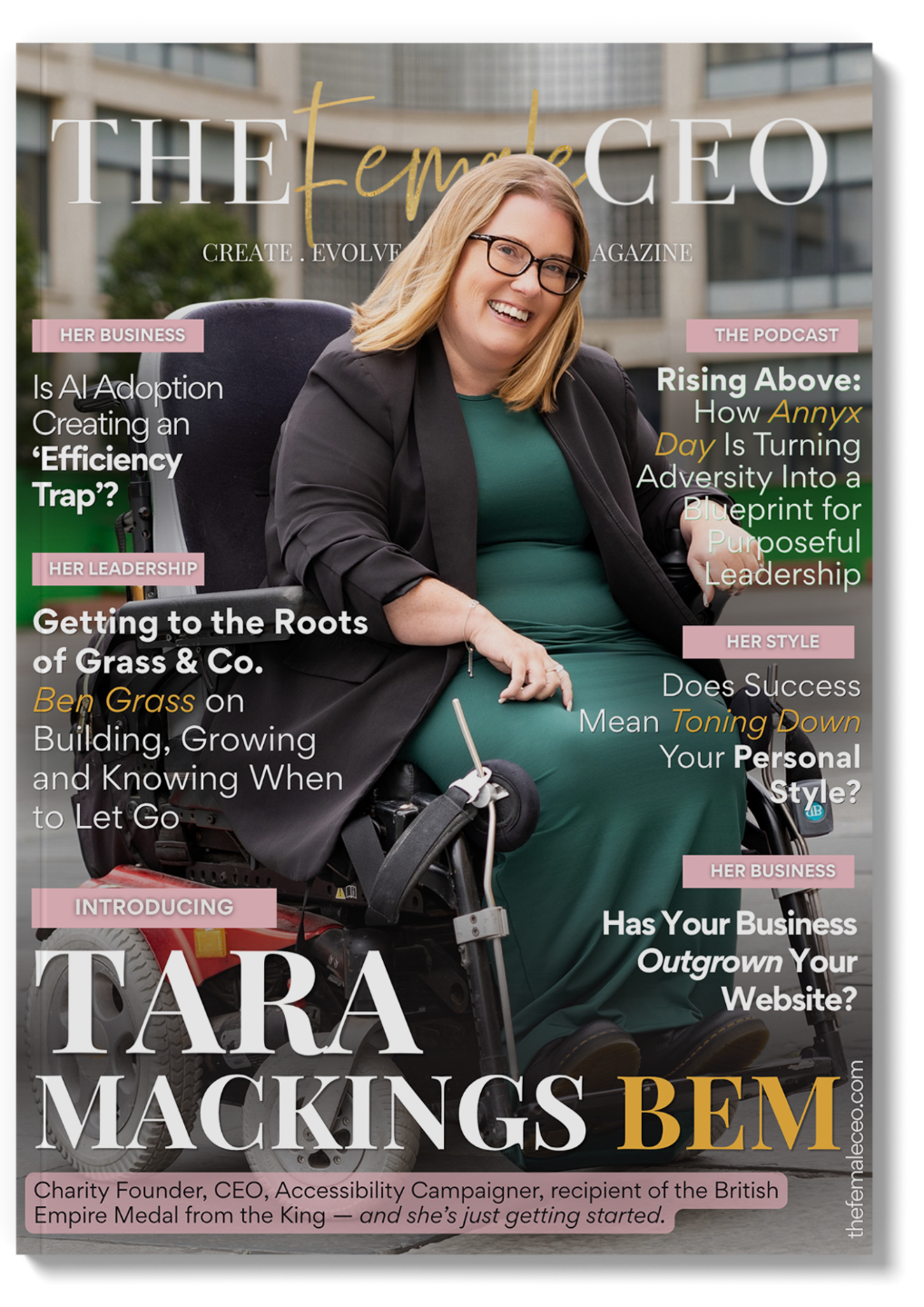
"I'M NOT DONE": HOW TARA MACKINGS BEM IS MAKING ACCESSIBILITY EVERYBODY'S BUSINESS
UK National Inclusion Week ended on the twentieth of September. The lanyards went back in the drawer. The panel events wrapped up.
Somewhere in the North East, a woman is sitting outside a building with an intercom fitted three feet too high, working out whether she can reach it with a stick.
"Someone give me a stick and I'm gonna poke that thing, and I'm gonna get in," she says. "And then I'm gonna tell them that intercom's crap and it's too far away."
Tara Mackings BEM has spent six years turning that exact instinct into a charity, a fitness model, a community café, a national accessibility rating system and a medal from the King. This year's National Inclusion Week theme was "Build Trust. Navigate Change." Tara has been doing both since long before anyone gave it a hashtag, and she has a very specific view on what happens when lived experience becomes a tick in a box.
"We need to talk to you about your lived experience, and that's great, and we'll just put that on our report and say that we've spoken to you," she says. "But what does that look like in meaningful action?"
I should tell you, before we go any further, that I have rarely laughed as much in an interview as I did in this one. Tara is warm, quick and very funny, and she will have you laughing about an accessible toilet before you have quite worked out what she is actually telling you.
She is also a woman who once told the King's office to find a different venue.
The girl who was never told she couldn’t
Tara grew up in a house where you got on with it. Her parents have been married forty-two years. Northeast workers, both of them.
"It was never an option for me when I left school that I wasn't going to be exactly what I wanted to be."
So, she got to work. She was, she says, the youngest bank manager Lloyds TSB ever had. She was just eighteen years old.
Then she decided banking was not for her (and, in her own words, a bit boring).
What followed was a career built entirely around other people: counselling, then youth and community studies, then fifteen years working with young offenders, supporting them through the pre-court process so they wouldn't be criminalised and trying to pull them out of the pattern before it set. A job she loved.
Then came voluntary redundancy, and a question with no obvious answer. "What am I going to do in real life now? Because that was my plan."
Twenty-five interviews and a soul almost destroyed
Here is the part of the story that should make every employer reading this sit up and take real notice.
Tara had a degree. She had worked since she was seventeen, much of it in senior management. She was, by any measure, exactly the kind of hire organisations say they are looking for.
She went to twenty-five interviews.
"Oh, we didn't know that you were going to come in a chair. Oh, we don't have wheelchair access."
Twenty-five.
"My soul is destroyed," she remembers thinking. "What will I do now?"
Without employment on the horizon, she went back to volunteering. Eventually she found work in healthcare, in patient engagement, where she spent her days listening to red tape explain why things couldn't be done, and which barriers people would simply have to live with. Her response to that, then and now, is two words.
"Why not?"
And underneath those two words sits the sentence that built everything that came after. For a long time, Tara had resisted being seen only as a disabled woman helping other disabled people. Then she turned it over and looked at it the other way round.
"Why the bloody hell not? Because I know it, and I face it every day."
That morning in the car park
Employed by the health service, Tara describes the treatment she received there as "nothing short of outright discrimination."
Then one morning she drove to work and, rather than going inside, she sat in her car and cried. She had simply had enough. She called one of her team. "You need to talk to me all the way home," she said. "And I need to go and get some help."
"It was just systematically broken," she says now, "and I didn't see a way out of it."
Of course, this being Tara Mackings, she found a way out of it. But it is worth taking a moment to recognise that the woman who would go on to be honoured by the King for her service to disabled people in the North East was, at that point, being ground down by a system that was supposed to be on her side. The barriers she now spends her working life dismantling are not abstract to her. She has been all the way underneath them.
Sit to be fit at home
The thing that changed everything was in fact, not a business plan. It was her son, Jack.
Tara is a mum of two. Around the time her own working life had collapsed, her son was going through an autism diagnosis and being homeschooled, and the family were playing what she calls "this mad game of don't drop the ball." Jack was hitting barriers at school that should never have been in his way, and watching that happen to her own child sharpened something in her.
Then Covid arrived, the entire country found itself at home, and it was Jack who said the sentence that started the whole thing.
"Sit to be fit at home."
So, they decided to film it and it and, without any level of expectation, it got around 350,000 likes across the social platforms.
Tara had always struggled with exercise. She couldn't use a standard gym independently and, despite an extensive search, she struggled to find a personal trainer willing to take on someone with a physical disability and long-term conditions. Undeterred, she approached two instructors and asked them a question she has since asked a lot of people.
"I've got this idea. Will you take the risk? Will you jump?"
They jumped.
Then, on a Friday night, with a glass of wine in hand, she wrote a bid. It was her first National Lottery application. She asked for £10,000 and she got it.
Sit To Be Fit At Home was born, three rounds of seated exercise were developed, hundreds of people came, and within weeks they were on ITV.
From a church hall in Fulwell, Sunderland to 120 people a week
What started as seated exercise did not stay as seated exercise.
Crafts at home came next, then, because people were telling her how rubbish they felt, and some of her clients had gone months seeing only their carers come through the door, wellbeing sessions.
When lockdowns ended, Tailored Leisure took the model out across the North East of England, running outreach with partners including the MS Society. Then they got a base of their own at New Springs City Church in Fulwell.
They currently host more than 120 people a week across three days, with seated fitness, boxercise, yoga and seated dance on offer. Tara takes great joy in telling me that their oldest client is ninety-one. All of the classes are all fully funded, so they're free to attend to those who need them.
As tara points out, the sessions are not really about exercise. They are about community and connection - the cuppa afterwards, the people who save you a seat, and the fact that somebody notices if you don't turn up. Ask Tara why it works and she doesn't talk about programming. She talks about safety - knowing your needs will be met before you arrive and knowing that no one in the room is going to make a thing of it.
"They know they're safe, they know their needs are met, they know everyone welcomes them, and there's no judgment."
Then she says the thing that should probably be printed above the door of every service designed for disabled people in this country:
"We've built it with them, not at them."
In 2026 the National Lottery Community Fund backed that model with £270,000 over three years. Tailored Leisure also formally became a registered charity, having started life as a CIC in 2019. There is a community café now, launched this year with a local school and Gateshead College, training young people pre and post-diagnosis in real employability skills. Last year the organisation supported more than a thousand disabled children through the HAF programme with Together for Children and ran nearly four and a half thousand Sit To Be Fit participants through its classes.
The ethos has never moved: let's focus on your ability, not your disability.
The butterfly of the north
This is the point in our conversation where Tara stops being a charity leader and starts being something much closer to a national campaigner.
Tailored Leisure has trained staff and volunteers to audit venues for accessibility — not against the minimum the guidance demands, but against what it is actually like to arrive somewhere as a disabled person and try to have a normal day out. Volunteers can train as access champions. They've done commissioned work with Bamburgh Castle, Spanish City and the Life Science Centre in Newcastle.
Life put in a new lift on the back of their audit. Then won the most accessible venue in the North East at the regional tourism awards.
Bamburgh invested in a buggy so visitors can get to the top of the castle, with staff meeting people in the car park.
The long-term ambition is a rating system — the Butterfly of the North. Businesses would be rated out of five butterflies, using Tailored Leisure's own butterfly logo, and the model is deliberately borrowed from something every customer in Britain already understands.
"You go to a restaurant, and you get a five-star food rating."
Underneath the rating sits the commercial offer, built in three layers, "a bit like a cake" Tara points out. A surface audit gives you the quick fixes. The middle layer handles the short to medium term. The full commission of around six visits covers staffing, training and the venue itself, and arms the business with the evidence it needs to chase a grant for a lift or a changing places toilet, by showing exactly how many more customers that investment lets through the door.
A prototype for the accompanying app has already been built with Northumbria University. Tailored Leisure goes after investment for it in December, and Tara would quite like the government to notice.
"Better still, the government invests. A bit like they do with the food hygiene rating."
Why the sink is in the wrong place
If you want to understand what lived experience actually buys you, it's this.
Accessible toilets in the UK are designed so that the sink sits within reach of the toilet. There is a reason for it. There is also, Tara points out, a problem with it.
"I've got no desire to wash my hands while I'm sitting on the loo."
She is laughing while she says it. She is also completely serious.
"For me, as a wheelchair user, the sink's just in my way when I'm trying to do a transfer."
Of course, the design is not malicious. The designer simply wasn't the person doing the transfer. And that, in one small sink-shaped example, is the whole argument.
"You don't know what you don't know, because you're not living it."
She is every bit as quick to tell you when somebody gets it right.
"I go places for dinner and the chairs are already out. They're waiting for you, because you've said, oh, we're two wheelchair users."
No shifting furniture. No embarrassingly moving other diners out of the way. No arriving somewhere and instantly becoming an event.
She has harder examples too. A few months ago, she and her fiancé, also a wheelchair user, travelled by train after the previous service had been cancelled. The carriage was rammed. There was a double buggy parked in the wheelchair space, suitcases piled high with nowhere else to go, and the two of them wedged facing a wall for three and a half hours. They could not have reached the toilet. They could not have gotten out.
"That's not us asking for a free upgrade. That's just us expecting basic safety standards to be adhered to."
And in all of this, the business case has been sitting there the whole time. The government talks about the purple pound, and the billions disabled visitors represent. Get it right, Tara points out, and those visitors come back.
"I can think of countless holidays I've had where I've gone to the same place, because I know what I can expect in terms of access."
It isn't a question of whether a business should. It's a question of why wouldn't you?
Handing over the baby
In among all of this, Tara made a decision that most founders would find almost unbearable.
Moving Tailored Leisure from a not-for-profit to a registered charity meant long-term funding, sustainability and structure. It also meant something much harder.
"I had to step down from what I had known. I have to hand it over and trust the trustees with everything I had worked for."
She did it anyway. A risk she was prepared to take for the benefit and the longevity of Tailored Leisure. What she got back was the thing she had been missing for years. The weight stopped being hers alone to carry.
She is refreshingly honest that the transition has not been easy — a personal and professional adjustment, learning everything the Charity Commission expects while still running the actual organisation. And then there is the particular agony of learning to hand work to other people, which she describes in terms every founder will recognise.
"You have to manage someone else, and you just feel like, I could have done that much quicker if I'd just done it myself."
That phone call in a supermarket car park
Tara does not usually answer withheld numbers on her mobile. She very nearly didn't answer this one.
She was sitting in her car in a local supermarket car park, waiting for one of her children, when a number she didn't recognise came up. The voice on the line announced that it was someone from the King's office. The very first Birthday Honours of the new reign, and she had been awarded the British Empire Medal for her service to the community.
Her first response was… "Is this a wind-up?"
There was a pause on the line.
"I have no idea what a wind-up is," the woman said. "But it's most definitely not."
She still doesn't know who nominated her. Nominations go in anonymously — snippets of a life, gathered up from people who have watched you do the work and compiled into the reason you are being recognised.
"You do these things not for the medals, do you? Never in my wildest dreams did I think, when I started Tailored Leisure, that that's what somebody thought."
After an hour in her company, that is the most Tara answer she gave me all morning. She has a medal from the King, and she is still faintly baffled that anybody was watching.
“We’ll have to give you the medal from the back of the room”
And then the part that is so absurd it would be funny if it weren't so ridiculous.
The first venue proposed for the presentation was not wheelchair accessible. She could still have her medal, she was told. She would just need to receive it from the back of the room.
While everybody else received theirs from the front.
"Hang on. I've earned a British Empire Medal from the King for my community work that I've led for disabled people, and you're now telling me I've got to accept it in a non-accessible room, from the back of the room?"
"Is this a wind-up?" she asked. Again. Then: "Absolutely not. Can you find me another venue?"
She laughs as we discuss it now.
"They we’re probably thinking, who gave this woman the medal?"
They did indeed find another venue. On the fifth of March 2024, at South Shields Town Hall, Tara Mackings received her British Empire Medal.
From the front of the room. With her family watching.
"If I'm not going to be true to what I deliver every day, then I'm not," she says. "That's one of the biggest moments of my life. So why shouldn't I accept it from the front of the room, in my biggest moment, with my family?"
She is clear about what it costs to have to keep asking. "It makes you feel uncomfortable. It exhausts you that you still have to have those conversations."
Her dad has a line about it. "Nothing's changed, pet. Since you were tiny."
He may well be right about the world. He is also a man who raised her never to accept it.
For the woman who’s been told the door doesn’t open
I first met Tara at an International Women's Day conference, where we were both speaking. She went on after me. She told me afterwards that she had sat there with her notes, decided they were no use to her, and winged the entire thing.
She was the best speaker in the room that day. I have never forgotten it, and I don't believe anybody else there has either.
I tell you that because Tara Mackings does not think of herself as an inspirational story. She thinks of herself as someone who noticed a problem she was personally standing in and refused to accept the explanation she was given for it.
Her argument, in the end, is not really about disability at all.
"You can be going about your life, and a family member might have a stroke, or fall into cancer, illness. You don't know what you don't know, until you're placed in that position."
Which is why she thinks accessibility stopped being anybody's special interest a long time ago.
"We all need to address the accessibility agenda as if it's all of our responsibility."
And when she talks about what the work is actually for, it stops being about access at all. It becomes about the question she wants everybody to be asked. "It's about really looking at what somebody has, and where they want to be. And why can't you be there? Why can't you get there?"
If the answer is a door that won't open, her method is not complicated. She once wheeled into a supermarket with a handful of business cards and a leaflet and asked who she needed to speak to.
"And I'm not leaving until I've got a name."
She got an information table out of it. She counts that as a start. She counts everything as a start. Her strategy for the days in between fits into four words "Gotta laugh and lead."
Ask her where this all goes and she doesn't reach for modesty.
"I want a place around the government table."
Six years ago, she was in her living room with a glass of wine and a bid she had no particular reason to believe would be funded.
"It's nice to reflect. You forget, as a CEO or a leader, to go, look how far we've come."
Then, without missing a beat:
"But I'm not done."
And you know what? I fully believe her.
to follow