JESSIKA VON INNEREBNER AND THE QUIET POWER OF REMEMBERING WHO YOU ARE
Some people build businesses.
Some people build bodies of work.
And then there are people like Jessika von Innerebner, whose work feels less like something she does and more like something she’s been chatting with, playing with, and occasionally chasing down corridors her whole life.
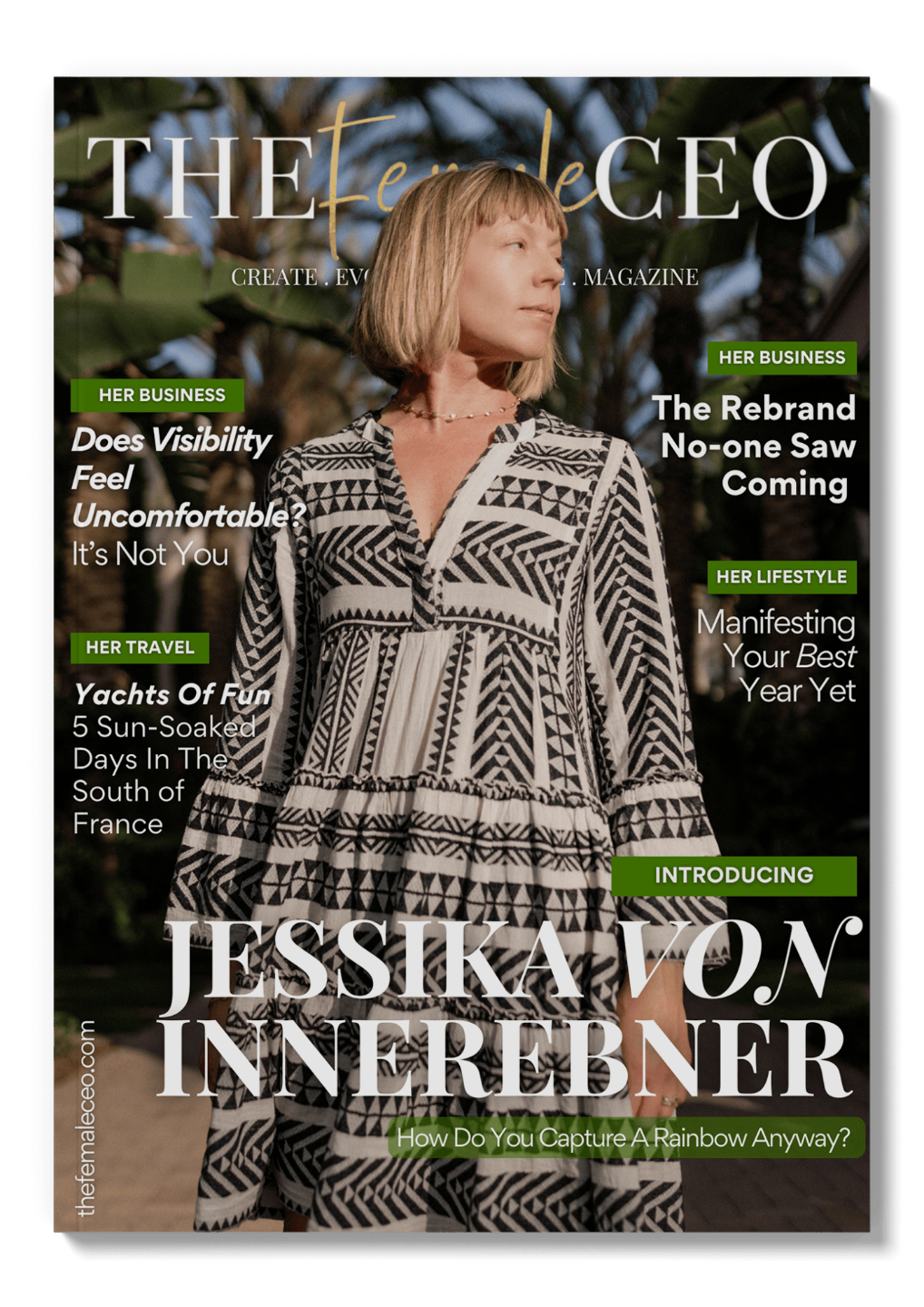
Jess is an author, illustrator, Lead Agent at The Bureau of What if’s and lifelong imaginator. A self-taught creative who landed her first professional illustration job at seventeen, she has since worked with some of the most recognizable names in global publishing and entertainment — Disney, Marvel, DreamWorks, Nickelodeon, Penguin Random House, Scholastic, and more.
But to reduce her story to clients or credentials would miss the point entirely. It’s also the reason this Spotlight doesn’t follow our usual format – Jess is unlike anyone I’ve ever met and to format her in such a way feels…off. How do you capture a rainbow? And that’s what meeting Jess feels like. You know something truly magical is unfolding around you but you can’t ever quite put your finger on it and the colours simply shift into something even more vibrant and never actually end.
Outside of her work, Jess can be found skateboarding, travelling, or sitting somewhere with very good coffee - observing, collecting, noticing and perhaps sketching.
A Creative Life, Lived from the Inside Out
Jess talks about imagination not as a skill, but as a place. Somewhere familiar. Somewhere she never fully left.
Her career has spanned illustration studios, publishing houses, and personal creative projects, yet the thread running through it all isn’t productivity or polish.
It’s permission. And not the laminated, officially stamped kind either - the scrappy, handwritten, ‘are we allowed to do this?’ kind.
Permission to explore ideas long before they’re useful.
Permission to let things stay unfinished.
Permission to take play and curiosity seriously in a world obsessed with certainty.
This way of working hasn’t made Jess louder. It’s made her more herself - more curious, more willing to follow a thought just to see where it goes, even if it doesn’t go anywhere at all.
The Art of Letting Ideas Breathe
Ask Jess a direct question and you don’t get a soundbite, instead you get an exciting window into how her mind moves. We asked:
If your imagination had its own bedroom, what would be on the walls? “They wouldn’t be tidy,” she says. “They’d be layered.”
One wall might be covered in maps of places that don’t exist. Islands labelled with impossible names, like ‘Candy Island.’ Secret doors pencilled in and erased and pencilled back again. A compass scribbled on the wall that always points toward maybe instead of north.
Another wall would hold memories pretending to be art:
-the first drawing of Garfield I scrawled out
-the exact color of blue I love
-ticket stubs from moments that changed nothing - and everything.
There would be questions written too big to ignore:
What if this worked?
Why not like this?
Who decided it had to be serious?
Some walls would be messy with thought bubbles, arrows going nowhere, and ideas talking over each other. Others would be strangely quiet, blank on purpose, waiting for the right moment to be interrupted.
And pinned above the bed, slightly crooked, would be something I made before I learned how to judge it.
“Not because it’s good,” she says. “Because it remembers me.”
That line alone tells you a lot about how Jess relates to her work - not as output, but as an inner relationship.
When Creativity Becomes Quiet Resistance
In a culture that rewards speed, hustle, and certainty, Jess’s way of working is quietly subversive and occasionally a little bit mischievous.
She doesn’t rush ideas to become useful.
She doesn’t force meaning too early.
She lets imagination stay weird longer.
We asked: If a tiny creature crawled out of your sketchbook and gave you advice, what would it say? It wouldn’t introduce itself.
It would crawl out smudged with graphite and eraser dust, blink at the room, and say: “Stop trying to make me useful so fast.”
Then it would tug at the corner of the page, like it was checking whether it could climb back in.
“You keep finishing things before they’re done becoming,” it would add. “Let them stay weird longer.”
And just before slipping back between the pages, it would look up once more and say: “You don’t need permission. You never did.”
Finally, it would leave a faint smudge behind. Not a mess but a reminder. I would then check my cup to see what I had been drinking.
This isn’t rebellion for the sake of it. It’s discernment.
Jess understands that when imagination is flattened, leadership shrinks with it. Problems lose depth. Solutions lose soul. Work keeps happening — but people feel largely absent from their own lives.
A Different Kind of Success Story
Jess’s books — including It’s Not All Rainbows, Why Can’t We Be Bestie-Corns?, That’s MY Sweater! and Sprout Branches Out — are playful, emotionally intelligent, and deeply human. They speak to children, yes, but they also speak to the adults reading over their shoulders.
They remind us that creativity isn’t something we grow out of, but rather, something we forget how to return to.
In many ways, Jess’s latest body of work feels like a natural continuation of that idea; not a departure from children’s storytelling, but a widening of the doorway. In conversation, she talks about Can You Imagine? less as something to work through and more as a response. A response to noticing how many adults feel cut off from the part of themselves that once played, questioned, and imagined freely. It didn’t begin as a product idea; it emerged as a way of giving that part of people a place to land again.
She describes Imagination HQ as something deliberately open-ended. Not a destination, but a starting point. Sometimes it feels more like a springboard than a structure - a place people can push off from and take the momentum somewhere entirely their own. Other times, it’s closer to a LEGO board: modular, playful, and quietly encouraging others to build on whatever’s already there.
That openness is intentional. Jess has never been interested in creating something people consume and complete. What matters more to her is what happens after, the questions that linger, the ideas that get carried away and reshaped, the sense that imagination doesn’t belong to one person or one project.
In that sense, the work has grown beyond a single format. It now feels less like a body of content and more like a shared language. Almost like a movement — though Jess would likely smile at that and remind you imagination tends to resist being organised for too long.
She describes it not as a platform or a hierarchy, but as a place. The Bureau of What Ifs is a fictional bureau — long established, recently reactivated — in response to a worrying global shortage of imagination. Levels have fallen dangerously low. The world, it turns out, runs on imagination. And ours is under strain.
Inside the bureau, Jess shows up as a guide, welcoming you in and reminding you that imagination itself is the star of the show. It’s a familiar Jess move: playful, self-aware, and quietly profound. Something collective. Something that doesn’t ask to be mastered, only remembered.
This role, part storyteller, part witness, part instigator, feels less like a new direction and more like a very Jess-shaped way of being in the world. Inviting others inside. Trusting that curiosity knows where it’s going, even when we don’t.
Because for Jess, imagination isn’t an escape from reality. It’s simply a return to one of humanity’s most profound and overlooked intelligences.
A Return to What Matters Most
This isn’t a story about scaling, optimisation, or building an empire.
It’s a story about building a life that still feels like yours.
Jessika von Innerebner represents a quieter, deeper kind of leadership — one rooted in curiosity, self-trust, and the courage to keep asking better questions long after the world tells you to stop.
In a time when so many women feel over-scheduled, over-stimulated, and under-inspired, her work offers something rare:
A sense of remembering.
A soft return
A feeling of oh… there you are.
If you're ready to return to the POWERFUL imagination-forward human you are meant to be we highly recommended visiting Can You Imagine? (Jetpacks included!)