
The Rest Test: What SLO Claridge House Taught Me About Playing the Long Game
By Tricia Scott.
There's a version of the long game that looks like relentless forward motion. More calls, more launches, more commitments stacked into every quarter until the year blurs into a single, unbroken sprint (and a runner, I am not). And then there's the version that actually works. The one where you understand, usually somewhere around year five or ten, or maybe on a random afternoon when you literally can't finish a coherent sentence, that restoration isn't a reward for hard work. It's the infrastructure that makes the work possible.
The Rest Test theory is about exactly that: six months of treating recovery with the same discipline I apply to strategy. And my stay at SLO Claridge House in Mayfair quickly became one of the clearest case studies in what intentional rest looks like when an entire organisation has thought about it properly.
A Building That Chose the Harder Path
Before you even walk through the door on Davies Street - part of Grosvenor's historic Mayfair estate - SLO's founding philosophy is already in the brickwork. Claridge House was built in 1924 - a neo-Georgian building in Mayfair that could, very easily and very lucratively, have been gutted and started again. It wasn't.
Instead, PDP Studio undertook what became one of London's most ambitious heritage retrofits: fully electric, zero gas, powered by heat pumps and 45 solar panels. The result is a building that produces 93% fewer carbon emissions than it once did, and that in 2025 won the Architects' Journal Retrofit & Reuse Award for Decarbonisation and Net Zero.
That detail really matters. Not just for the planet (though, yes, obviously for the planet), but as a statement about how SLO thinks. In a world that defaults to new builds and fresh starts, they chose the slower, more considered, and in my opinion far more beautiful, structurally complex option. The one that honours what already exists. That is, by any definition, playing the long game.
What the Stay Is Actually Like
Apartment Two. One night, the 23rd of June, arriving by train into a London that had decided, with absolutely no warning and no regard for anyone's plans or wardrobe choices, to become the surface of the sun. I am not exaggerating. As I stood there wearing jeans, it was the kind of heat that makes you question every life choice that led you to be outside. The kind of heat that turns a short walk from the station into an achievement worthy of at least a medal of some sort.
Which is why, when I walked into Claridge House and the air conditioning did what air conditioning is supposed to do (actually cool the air, not just gesture at it), I experienced something close to religious gratitude. It felt like the building had been expecting us (and it was, as lovely Alena accompanied us to the apartment and explained all about what we were about to experience). The temperature was perfect and I stood there for a moment longer than was strictly necessary.
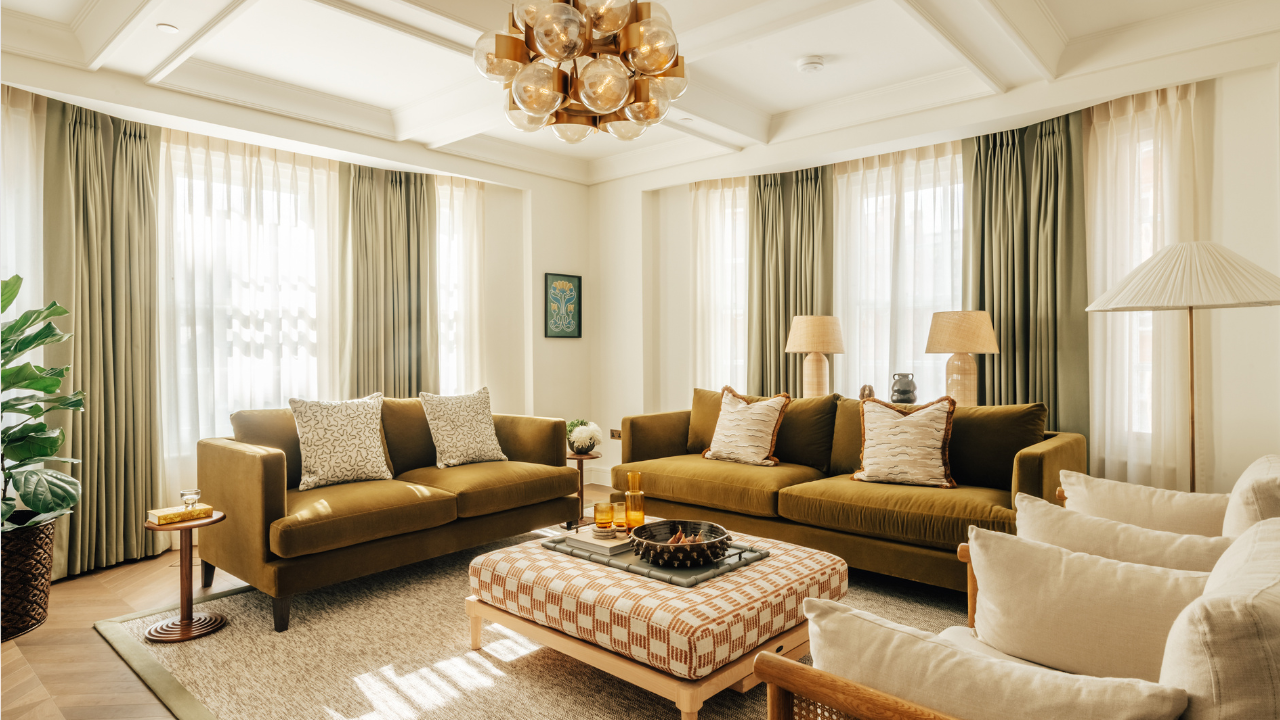
The first thing you notice at Claridge House, beyond the blissful cool, is what isn't there. No lobby buzz, no queue at a reception desk, no anonymous corridors or pinging notifications. The eight residences are designed to feel like somewhere you'd actually choose to live - and the difference is in the specifics. A fully equipped kitchen with state of the art appliances (not a kettle and a minibar that charges £7 for a Kit Kat). Reading nooks that look used rather than staged. Mid-century furniture by Robin Myerscough, the Galvin Brothers and Chelsea Vivash — made for decades, not for a product shoot.
An art collection by all-female UK artists brings something genuinely worth looking at into every room. Anatomé London scents and ritual cards in each room do something very specific to the nervous system the moment you walk in — I noticed I took a deeper breath within about thirty seconds. Hypnos mattresses (rumoured to be the best in the world, a rumour I can now personally verify) mean you sleep rather than merely lie down in a city that literally never sleeps and wait for morning. And real living plants give the whole place the impression of home rather than somewhere you're just passing through.
What SLO understands, and what so much of the hotel industry misses, is that the absence of friction is the amenity. A space that doesn't demand anything from you is, for most women running a business, rarer and more valuable than a spa break.
I slept very well, since you asked.
The Experience Doesn’t End When You Leave.
A little after the stay, a personalised carbon footprint summary landed in my inbox. Not a vague sustainability pledge or a card about hanging up my towels. A bespoke breakdown of the actual environmental impact of that specific night, calculated using GHG Protocol and DEFRA standards.
My stay produced 17.38 kgCO₂e - approximately 57.79% fewer emissions than a comparable night at a UK five-star hotel. Broken down by operational energy, diet, transport, cooking, shower use, even the housekeeping. (SLO's weekly housekeeping uses exclusively ecological cleaning products; a meaningful departure from the daily hotel clean that consumes enormous amounts of water and energy, usually without anyone mentioning it.)
We arrived by train, which the report noted produces just 0.04 kgCO₂e per km - one of the lowest-carbon travel choices available. Combined with the building's retrofit numbers, the whole trip sits far lighter on the ledger than most comparable experiences. Something worth knowing.
The reason this is editorially interesting isn't the data itself, it's the decision to measure and share it. Most luxury hospitality buries its environmental impact in the small print, or avoids the conversation entirely. SLO built a bespoke carbon calculator and sends you your personal summary as a matter of course. That's accountability as a practice. That, too, is the long game in action.
Rest as Strategy — The Real Takeaway
I'm not suggesting everyone needs to book a Mayfair apartment to recover from the relentlessness of running a business. (Though if the opportunity presents itself, I'm certainly not suggesting you say no either.)
What I am suggesting is a principle that SLO makes tangible: you get out of a space what it was designed to put in. A hotel room with the news channel on and the minibar as the only entertainment is not rest. A weekend where the laptop comes "just in case" is not rest. An environment that's been genuinely designed to slow you down, restore your nervous system, and give you room to think - that is. And you will feel the difference in your work the following week.
The women I most admire in business, the ones building things that are still standing at year fifteen and twenty, are rarely the ones who are proudest of how little they sleep. They are the ones who have made peace with the rhythm of output and recovery, and who protect the recovery as seriously as they protect the work.
SLO sent me a carbon footprint after my stay. What would it look like to measure your rest with the same specificity? To know, concretely, what restores you, what depletes you, and which choices return you to your work sharper rather than simply less tired?
That's the long game. And it starts with taking the question seriously.
The Rest Test Continues.
If this issue's theme has been sitting with you — the long game, the slow build, the choices that compound over time — come and find us. The Female CEO podcast goes deep on the unglamorous side of building something that lasts. And if you're ready to get visible in 2026, we'd love to talk — find out how to feature with us here.
FAQs
What is SLO Claridge House? SLO Claridge House is a sustainable aparthotel on Davies Street in Mayfair, London. Housed in a sensitively retrofitted 1924 neo-Georgian building, it offers eight one- to three-bedroom residences designed for short breaks and longer stays. The building is fully electric, zero gas, and powered by heat pumps and 45 solar panels — producing 93% fewer carbon emissions than before its retrofit.
Is SLO Claridge House suitable for solo female travellers or women travelling for work? Very much so. The residences are private, self-contained and designed to feel genuinely residential — with beautifully equipped kitchens, reading nooks, and none of the anonymous hotel-corridor atmosphere that makes some stays feel more anxiety-inducing than restful. The Mayfair location means easy access to central London without too much of the tourist bustle.
How sustainable is the stay? Significantly more than the alternative. SLO sends each guest a personalised carbon footprint summary after their stay, calculated using GHG Protocol and DEFRA standards. Arriving by train keeps arrival transport emissions very low, and the building's retrofit means operational energy use is a fraction of a conventional hotel's.
What makes SLO different from a boutique hotel? The residences are designed for living in rather than passing through. Think full kitchens, expansive hosting areas, dedicated study spaces in some apartments, curated book collections, board games and a bespoke SLO playlist. There's no daily housekeeping (weekly, with ecological products). It's the difference between being accommodated and actually resting.
How much does a stay cost? Rates start from £550 per night for a one-bedroom residence, up to £2,250 per night for a three-bedroom apartment. Book at stayatslo.com/claridgehouse.
At The Female CEO, we believe in the power of shared knowledge and experience. If you have insights, expertise, or an inspiring story to tell, we’d love to feature you! Whether you're a seasoned entrepreneur, a budding business owner, or someone with wisdom to share, this is your space to shine.
📩 Get in touch to contribute and join our incredible network of female founders and change-makers.