Nobody Called It a Real Job: How Shadia Sabagh Built an Art Business on Her Own Terms
You did it this morning, probably without noticing.
In the bathroom before anyone else was up. In a lift. In the black screen of your phone before it woke up. You caught your own eye for half a second and said something to yourself, and it went by so fast you'd struggle to repeat it now.
That half-second is where Shadia Sabagh's newest work begins.
"When we look at ourselves — at the restaurant, washing our hands, on the phone — we're having these talks within ourselves," she says. "Telling ourselves either really positive things, or really negative things."
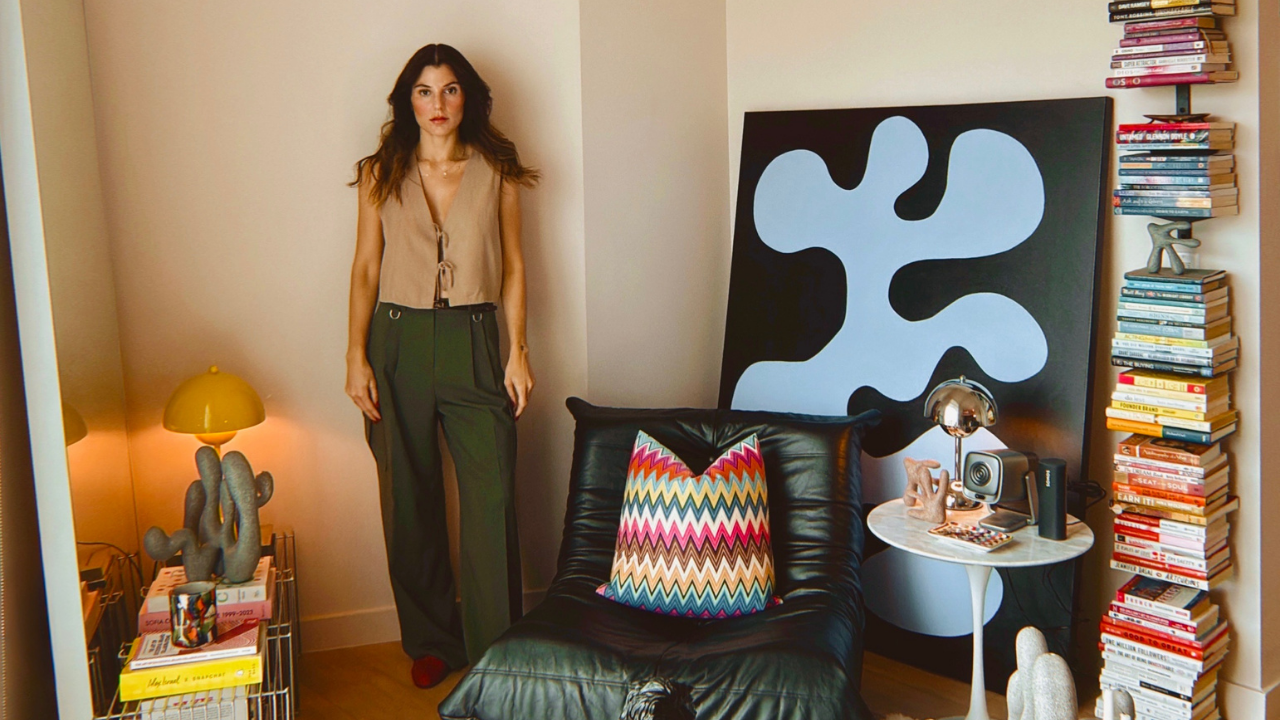
She’s a Miami-based artist and creative director whose studio has built rooms for YSL Beauty, Carolina Herrera, L'Oréal, NYX, Bacardi, CeraVe, New Balance and Airbnb.
It took her a very long time to get here. For most of it, she was told this wasn't even a real job.
The Career Nobody Wanted Her To Have
Shadia knew from the beginning.
She was the child who did her homework unprompted, the one her parents called an old soul in a small body. She was also the child who said she wanted to be an artist, and was told repeatedly that art is a hobby. Not a career.
"I've always wanted to be an artist," she says, "and nobody supported me. Ever."
She went to fashion school. That wasn't a real career either, apparently.
Then her father was diagnosed with cancer. Her parents' marriage ended. And at eighteen, she picked up her father's business and carried it while he was dying. The move to New York she had planned was set aside.
What came after was the hardest stretch of her life, and she came out of it with a decision she has essentially been repeating ever since.
"If people didn't believe in it, that's their problem. I believe in it."
So she got a job in hospice and healthcare. And she made her work on the side.
For seventeen years.
Not a sabbatical. Not a side project with a launch date. Seventeen years of clocking in somewhere else and coming home to build the thing she still believed in.
"You don't need a partner," she says. "You don't need permission. You don't need your parents. You don't need anybody."
Look at her today and it's a compelling case.
Seventeen Years Of Other People's Last Days
Ask her where the next chapter came from and the whole conversation begins to reorganise itself. Hospice work means being present at the end of a great many lives, and Shadia started asking her patients, "what do you regret?"
She laughs at the memory. "I was like, oh my God, Shadia, you're going to get in trouble."
But they all told her the same thing.
Not taking action. Not following their dreams. Wasting the time. Not telling people how they felt. Nobody said I wish I'd been more careful. Nobody said I wish I'd waited until I was ready.
"I saw death every day for seventeen years," she says. "I could die tomorrow. I want to die happy. I want to paint."
Listening to her talk it's obvious that this isn't a motivational line. It's an actual operating system, built out of other people's final days, and it explains every decision that comes after it.
How She Actually Paid For It
No investor. No loan. No inherited runway. No gallery underwriting the early years.
"All I did was, I got a job, and I did it on the side, and I would save."
Shadia is unusually open about what it actually took to build a business organically. She didn't spend her money on things that look like success. Instead she saved, bought materials, made one piece, sold it, and reinvested the proceeds straight back into growth.
Art fairs run the same way. A booth costs thousands. Shipping, thousands more. Not to mention materials, flights, hotels, machines and tables in her studio and the cameras she shoots her content on. All of the costs leave before a single piece sells.
Every fair is financed up front and paid back out of what sells. Then she does it again.
"I have no shame doing it," she says.
She's equally unembarrassed about what her time is worth. When people who ignored her five years ago turn up asking to be taught (and they do), she simply sends them her hourly rate and a link to her booking calendar. Some of them are startled. She is entirely unbothered.
"I'm not bragging. I'm confident. You know how many years I wasn't confident? How many years I toned myself down?"
Why She Sells Direct
Shadia's gallery experience is limited to a handful of shows. Everything else has been artist-led fairs, pop-ups, and her own Instagram — selling direct, talking to her collectors herself.
The reason is arithmetic rather than principle. "The economics haven't made sense for me — the commission on each sale is substantial, so I've chosen to work directly with collectors."
Selling direct turns out to suit her. A gallery hangs your work to its own taste, in its own room, with its own person standing beside it. "I have a very specific eye. A very specific sense of style that I want somebody to understand and get and feel and they're only going to get it if they're in my energy."
So she builds the room herself.
She's been doing the fairs for the best part of a decade, mostly in New York, and she describes them with real affection. Nobody staring you down. No price tag doing the talking. Just people who want to know why you make what you make.
She tells us she met her closest friends there. Her collectors, too. She describes it as "a different calibre of humanity."
It's also the thing that worked. "These are the reasons I've been able to succeed as an artist."
Why A Mirror?
Which brings us back to that half-second.
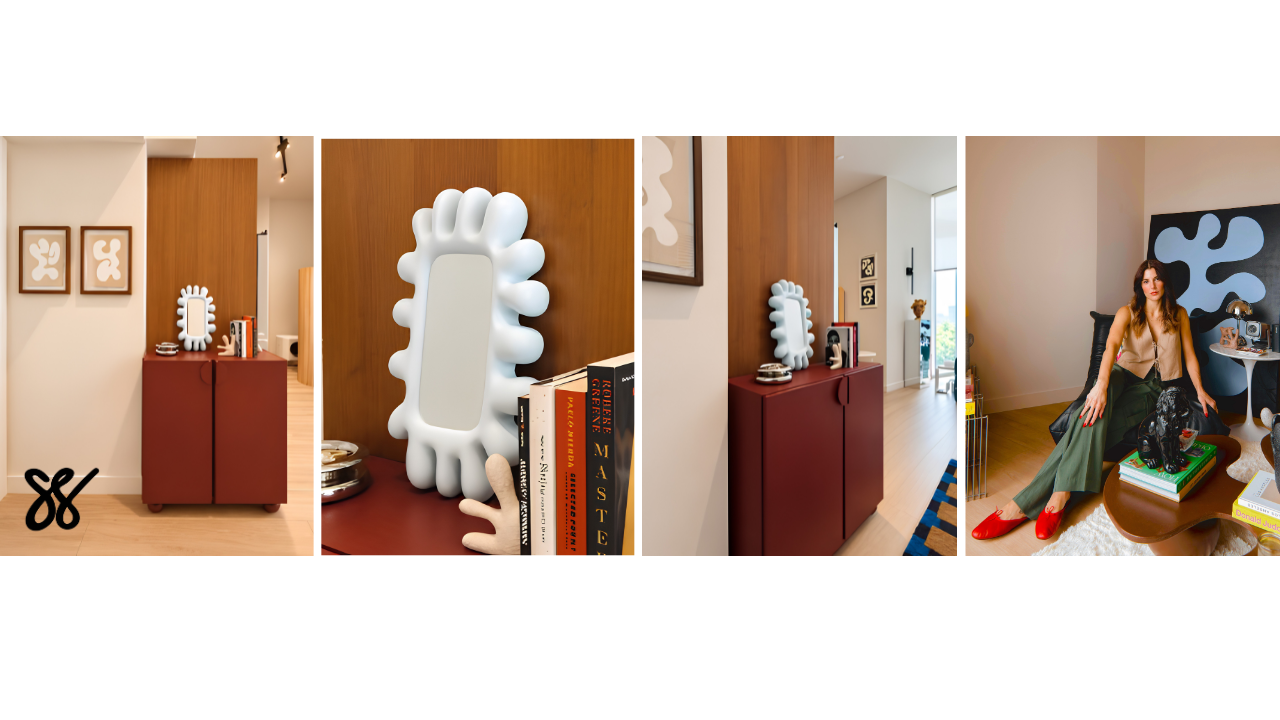
Mirror is, first and most simply, a mirror. A sculptural one — hand-cast polyresin, soft sky blue, a sixteen-point radial frame — in a limited edition run of 2,000, each one hand-sketched, rendered, moulded and then finished by hand, so no two are quite identical. It hangs at the height where you'll catch your own eye.
Three years of developing the resin practice sit behind it. Self-taught.
It's also the first piece she hasn't funded entirely alone.
"I wanted to try crowdfunding — I'd never done it before, and it's a way to fund a project beyond what I bootstrap myself," she says. "This piece needed a bigger investment than I could make alone."
Every Mirror arrives with 120 digital self-worth and self-love affirmation cards, which is the point at which she stops selling an object and starts handing over a practice. Mirror work is exactly that — holding your own gaze and saying something kind on purpose, rather than whatever your head reaches for first.
"Mirror work has been part of my morning routine for years," Shadia says. "I journal, then I do affirmations for self-worth and self-love. I wanted Mirror to carry that same energy."
"I want Mirror to serve as a reminder every time you look at it," she says. "To love yourself the way you want others to love you. First, always."
Mirror launches in person at The Other Art Fair: Los Angeles, 24–27 September 2026, at Barker Hangar in Santa Monica. The Kickstarter runs until 22 September, with two tiers — Soft Sky Blue and Signed in the Back — and estimated delivery December 2026. Back the campaign here.
What's Next
Two things, and both of them come straight out of everything above.
The first is Studio 888 by SS — her platform for brand work and her own line of journal editions.
The hospice years are following her into the second. Shadia is developing a programme around purpose, built partly from the questions she spent years asking herself, and partly from the answers she heard from people approaching the end of their lives.
"I spent sixteen years finding my own purpose and asking the questions it takes to get there," she says. "What's next is a program that gives people a shortcut to find theirs, with a map to follow it."
She describes herself as someone who turns ideas into gold.
"Some days it's literal."
The Waiting
Shadia doesn't pretend any of it was graceful.
She talks openly about having to believe in herself first. The years of doing it around a job. The fairs she paid for in full before she'd sold a thing.
She could have waited. For a gallery. For the money. For her family to understand. For somebody else to agree that this was a reasonable way to spend a life.
Instead there are collectors in more than fifteen countries who found her without a gallery in between. And a woman who spent years learning to trust what she saw in herself has made an object that asks everyone else to look at their own reflection properly.
Because the people she met at the end of their lives didn't regret the risk.
They regretted the waiting.
About Shadia
Shadia Sabagh is an artist and creative director working across original painting, hand-carved wall sculpture and collectible design objects through Shadia Sabagh Studio, based in Miami. She also runs Studio 888 by SS, her platform for brand experiences and her own line of journal editions. Her brand collaborators include YSL Beauty, Carolina Herrera, L'Oréal, NYX, Bacardi, CeraVe, New Balance and Airbnb, and her work is collected in more than fifteen countries.
Entirely self-taught and self-funded, Shadia built her practice alongside a seventeen-year career in hospice and healthcare before taking it full time. She sells direct to her collectors through artist-led fairs, pop-ups and her own channels, and is currently releasing Mirror, her first fully self-authored collection.
Find her at shadiasabagh.com and on Instagram @shadiasabaghstudio. Commissions and enquiries: info@shadiasabagh.com
At The Female CEO, we believe in the power of shared knowledge and experience. If you have insights, expertise, or an inspiring story to tell, we’d love to feature you! Whether you're a seasoned entrepreneur, a budding business owner, or someone with wisdom to share, this is your space to shine.
📩 Get in touch to contribute and join our incredible network of female founders and change-makers.